
What does quality mean in customer service? What are standards and where do they come from? Standards refer to the requirements, specifications, guidelines or characteristics established for customer service. They should reflect and provide guidance on what needs to happen, that is, what you want to apply or replicate, across all customer interactions.
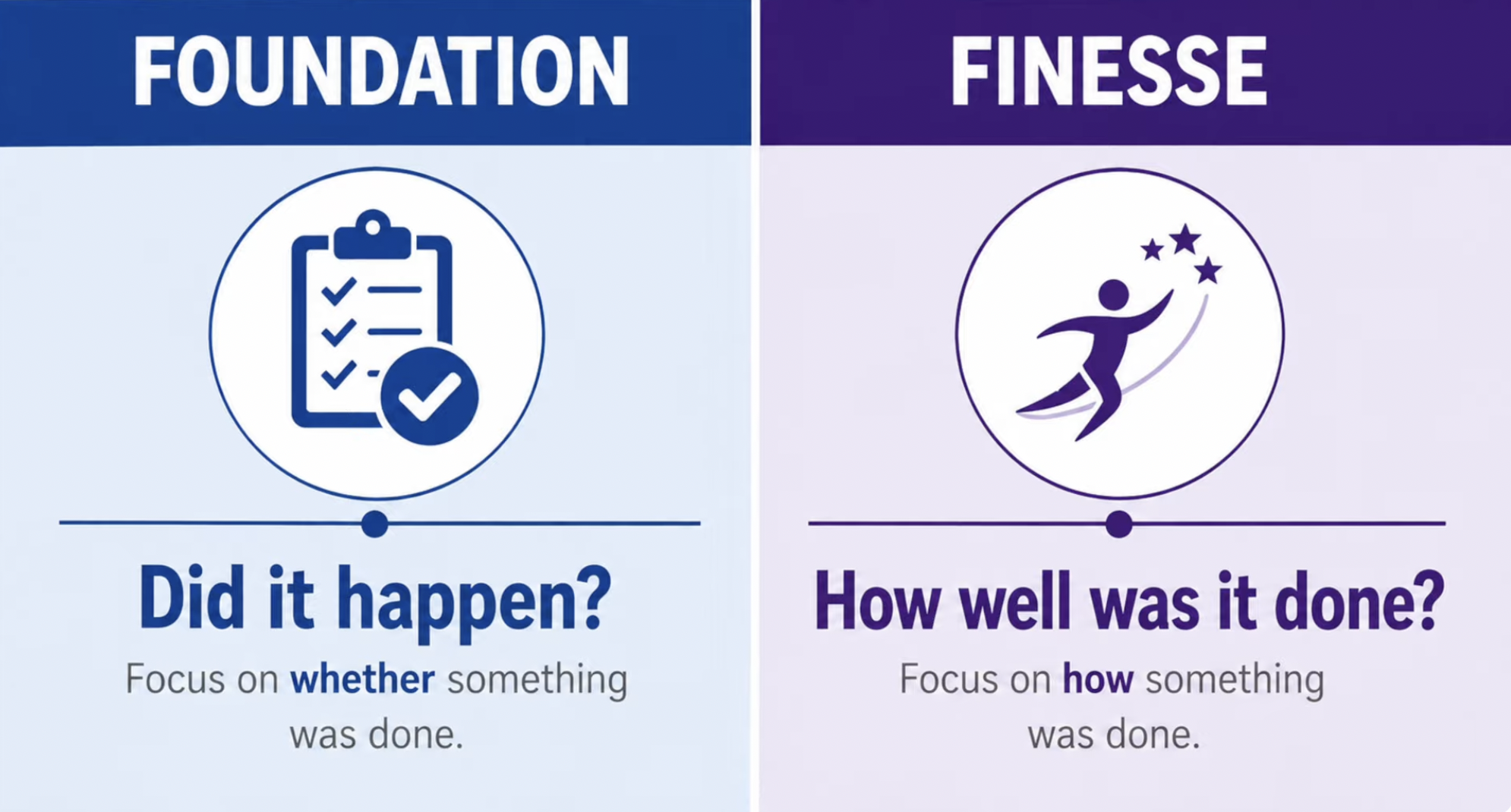
There are two broad categories of quality standards: “foundation” and “finesse.”
Foundation standards measure whether something was done, and can be assessed with a simple yes or no. For example:
- Verifies required information.
- Enters data correctly.
- Codes the contact correctly.
Foundation standards are objective and consistent. They apply equally to every employee and to AI-enabled service.
Finesse standards measure how something was done. They are more subjective, and are typically measured on a 3 or 5 point scale. They allow for style and individuality, and provide room for interpretation. For example:
- Listens carefully.
- Effectively probes for relevant input.
Think of high diving or figure skating in the Olympics. Finesse standards should provide clear guidance on what is expected, but performance happens in degrees.
We recommend having a mix of foundation and finesse criteria. I wouldn’t worry too much about the ratio. It could be 60/40, 40/60 or half and half. The breakdown will vary and depends on the specifics of your environment and what you want to see replicated across interactions.
We also suggest that you begin building your suite of standards by first identifying those that are foundation standards. What can be assessed by yes or no?
Think of piloting an aircraft. While flying might seem to be a matter of finesse, it is largely based on foundation criteria. Are you at the right airspeed? The right altitude? On the right radio frequency? Going through the right approach protocol to ensure landing gear are down?
When you identify those things that have to happen when delivering service to your customers, many will fall into this category. Consistency improves very quickly when you focus on getting foundation criteria in place.
Finesse requirements, however, are just as important, particularly in building customer relationships. This is where much of the personality of your brand can shine through. Finesse is where you can really differentiate.
Finesse standards should be backed up by detailed descriptions of the service characteristics you are looking for. They should also be supported by training, coaching and ongoing calibration to ensure everyone understands the standards the same way and delivers the essential components of service consistently.
These same principles apply when service is delivered by employees, AI, or some combination. For AI, foundation standards should include accuracy, compliance, appropriate escalation, and correct use of customer information. Finesse standards should include clarity, tone, and how well the system adapts to the customer’s situation. AI changes who or what delivers the service. It does not change the need for clear, consistent standards.
How many standards should you have? We recommend not too many. Just enough to ensure that the right service is delivered, that you capture insights you can use to improve products and services, and that your brand shines through.


0 Comments