
New products, marketing campaigns, support channels or accounts may not have much, or any, history you can use for forecasting new service. AI and self-service initiatives can change patterns that existed in the past. Even adjusting hours of operation can leave you with unknowns.
So, where do you begin? Todd Hixson—who has led workforce management initiatives for Hulu, Intuit, Travelocity and other organizations that have gone through explosive growth and change—offers sound advice. He says, “These are pioneer forecasts, and in every case, you need a volume and average handling time set.” Here are some examples:
Data from scratch. Sometimes, thinking out of the box yields surprisingly accurate data. For several weeks, a bank launching its first contact center had tellers manually track interactions with hash marks on simple paper forms divided by time of day. They also had them use a simple stopwatch to record samples of handling times. They looked at market size and clues to seasonality in volume and average handling time (AHT). Finally, they pieced these variables together into a surprisingly accurate workload forecast for the new contact center.
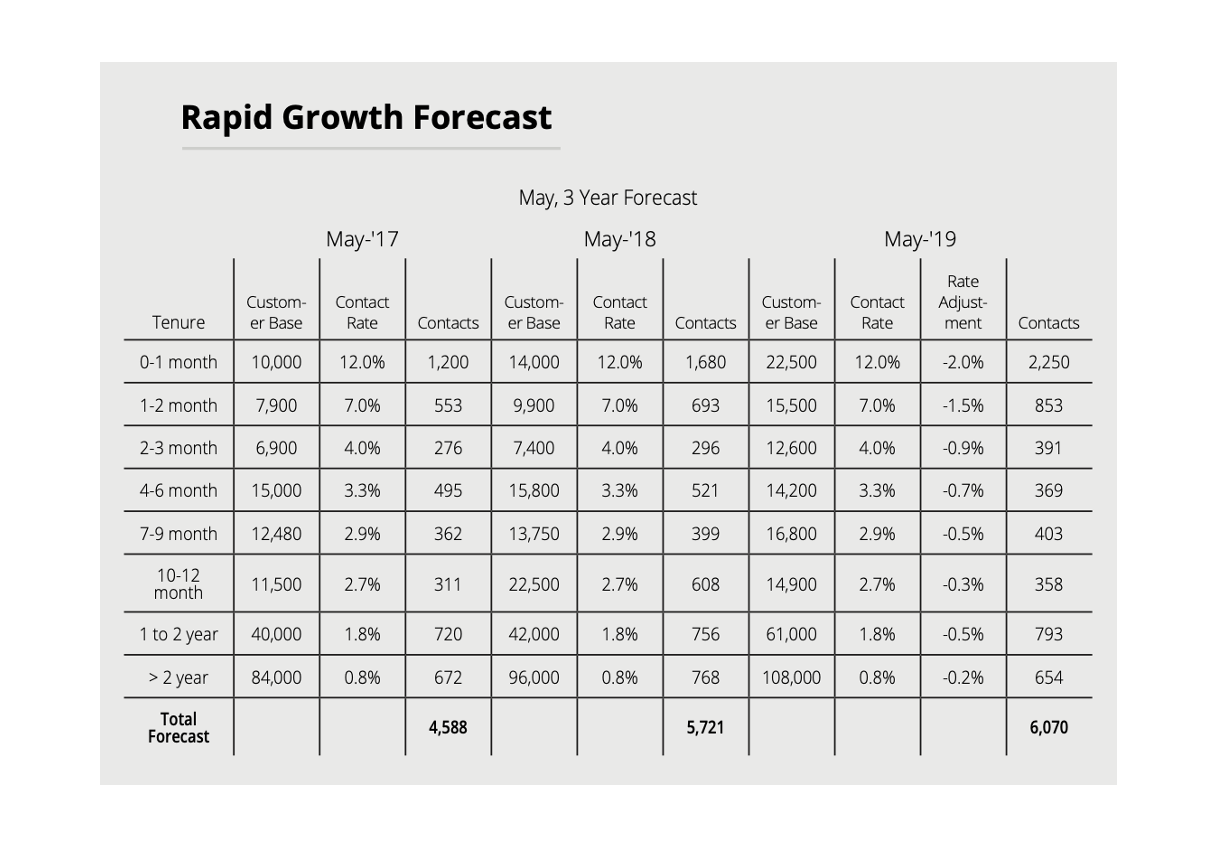
Rapid growth model. In some cases, rapid growth and product changes will negate the value of historical patterns. Because new customers contact your organization more often, one option is to look at contact rates by customer tenure, combined with anticipated growth. Begin with the current month, broken down by the tenure and contact rate. Next, look at projected growth, and work with your marketing team to predict tenure—down to future months or (even better) weeks. “You’ll also need to estimate the impact of new initiatives, such as product improvements,” recommends Hixson. (See rate adjustment column in the graphic.)
Deflection. “Eliminating or deflecting customer contacts through AI, self-help, live communities or product improvement can create havoc in historical trends,” says Hixson. “Be sure to partner with those working on these initiatives and build deflection estimates into your forecasts. And don’t forget that automation tends to offload the easiest contacts, leaving you with a higher AHT for those that remain. You’ll need to adjust both data sets.”
For any pioneer forecast, “create the data sets with a scientific approach in mind,” adds Hixson. “Get an agent’s point of view, then launch, learn and tune until you achieve a realistic historical sample. Then standard forecasting methodology can take over.”
Excerpt from Contact Center Management on Fast Forward by Brad Cleveland.


0 Comments