
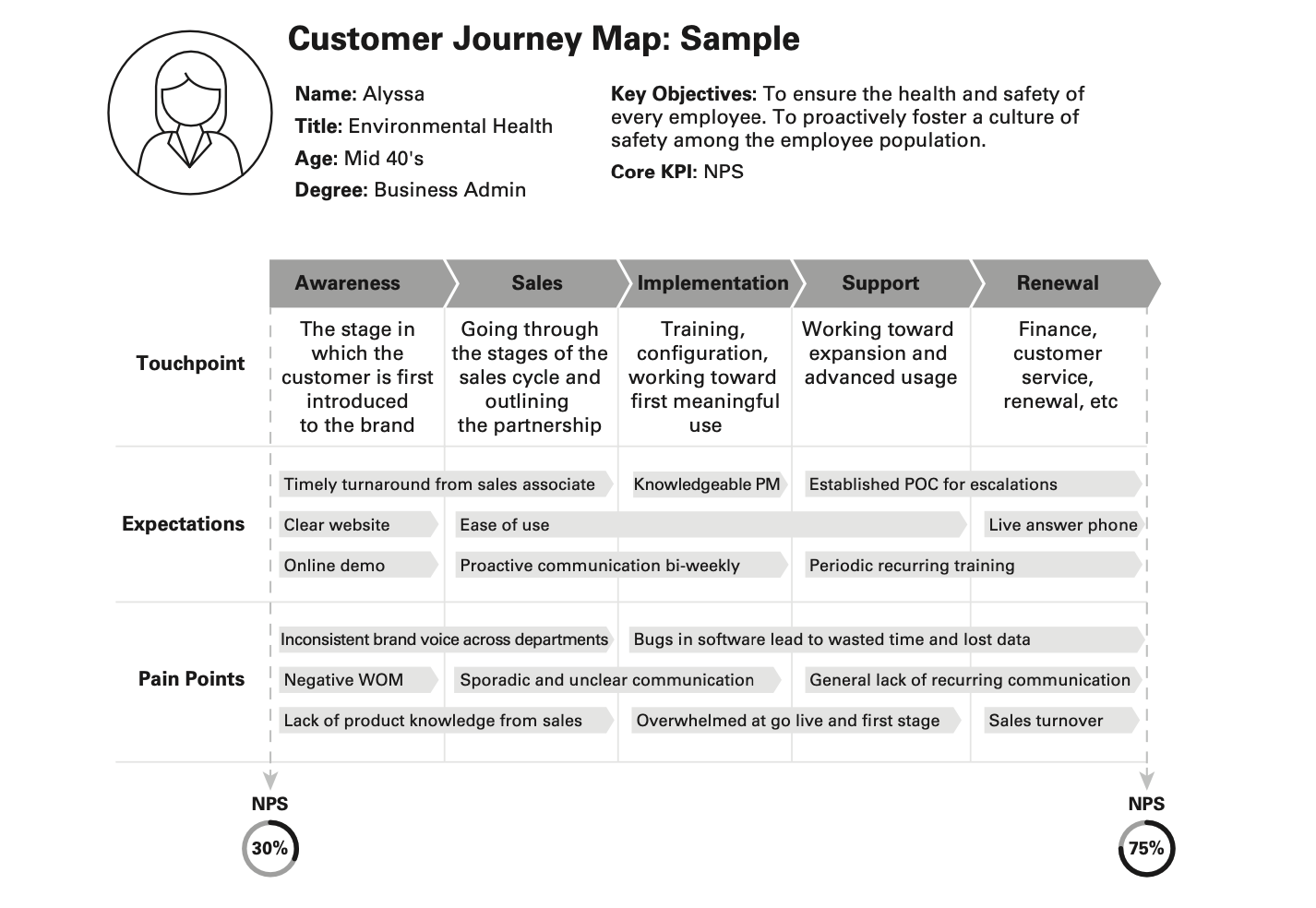
One of the most popular arrows in the quiver of a customer experience professional is the customer journey map. And for good reason… it’s a straightforward, effective way to visually depict a customer’s relationship with your organization.
Are your Customer Journey Maps gathering dust? Do they need updating? Here is a refresher on each element of the journey map and a reminder of the point of it all—a call to take action.
There are countless ways to map a customer’s journey, but the goal is the same: define a specific customer persona, and visually document their experience—the end-to-end journey. You’ll show them moving along a series of “touchpoints.” I’ll summarize the basic steps involved, but make this process your own. Maps created in a vacuum tend to stay there. The more collaborative your team is in creating the map and describing their part in the story, the more meaningful it will be. You’ll know you’re successful when anyone in the organization, regardless of department or role, can understand the map, and see where and how they are part of the journey.
Step 1: Create customer personas
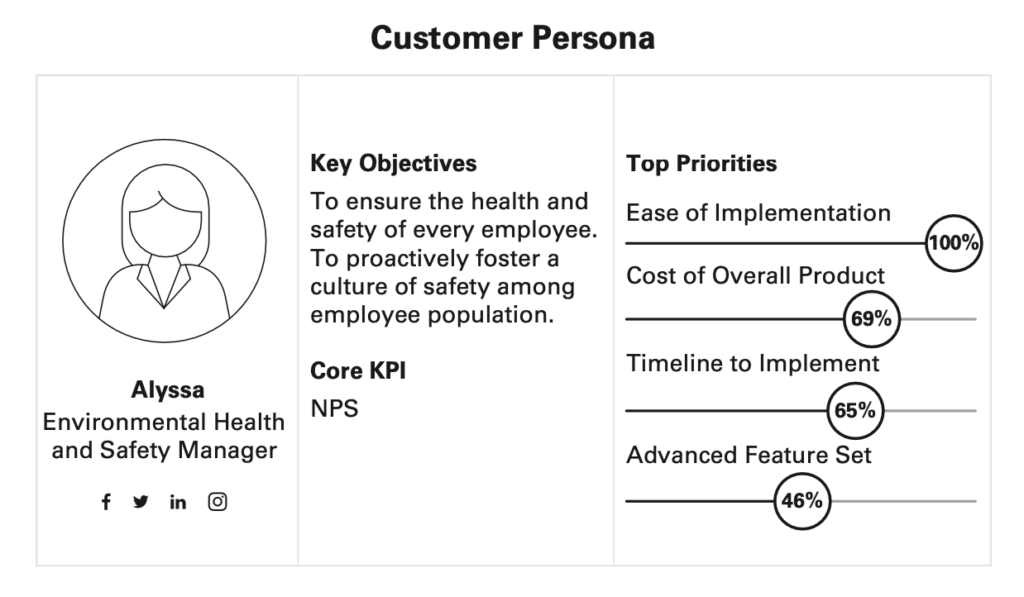
The journey mapping process begins by creating customer personas. The objective here is to identify a grouping of customers who share a relatively common journey. In other words, the key stages or “touchpoints” in their journey will be much the same. As a starting point, select the most common and straightforward customer group possible. The idea is that you will eventually have different personas and different maps associated with all of the various personas. But start simple; as your mapping skills increase, so can the range and depth of your maps. You have full creative control to customize these personas to fit your customers and audience. Here are a few recommended data points to include:
- Key objective: What does success look like to this customer? Why did they engage with your product or service in the first place? Describe in one to two sentences.
- Key objective KPI: What is the one overarching measurement that will determine the degree to which success is accomplished?
- Demographics: Itemize some basic demographics, such as age range, geographic region, etc.
- Challenges: What keeps this person up at night? What do they find difficult or inconvenient in their work and/or personal worlds?
Let’s say your organization provides management systems and training on health and safety. Alyssa, a customer, is an environmental health and safety manager. Her key objective is to ensure the health and safety of every employee. Her top priorities are training compliance and environmental improvements.
Step 2: Identify touchpoints
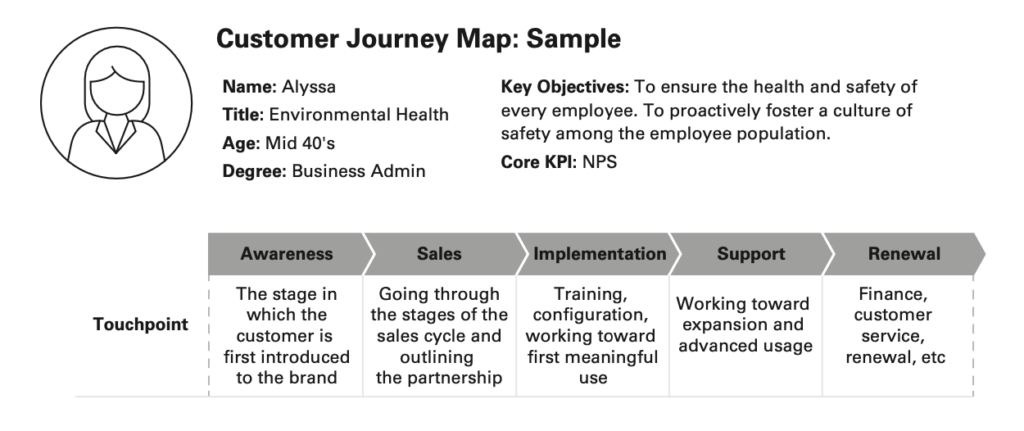
Now that you have a specific customer persona in mind, it’s time to isolate each important interaction between your business and that individual. This is written from the perspective of the customer, using their terminology wherever possible. Here, the map begins to take shape. Many organizations have found that simply isolating the touchpoints in a sequence can be a major eye-opener. This is not surprising as it represents a perspective shift for most—you are moving the focus off your business and forcing your group to think like the customer.
Naturally, every journey map is going to look different based on the types of interactions the customer has with your organization. That said, and to get you thinking, here is how a journey may progress:
- Brand awareness. The touchpoint at which the customer learns that you exist, and that you may have a solution to their problem. This step often coincides with needs awareness—the customer has a need and is now exploring possible solutions.
- Pre-sales. The stage at which the customer pursues additional information, receives a demo, and an account owner is introduced.
- Sales. The touchpoint at which a quote is provided, negotiations ensue, and the contract is executed.
- Implementation. The stage at which the customer is onboarded and begins to use the product or service.
- Ongoing support. The touchpoint at which invoicing or payment process begins; also, the customer may need assistance fromcustomer support.
- Renewal. The stage at which the customer decides to renew the product or service and potentially expand the partnership.
Step 3: Identify needs and expectations
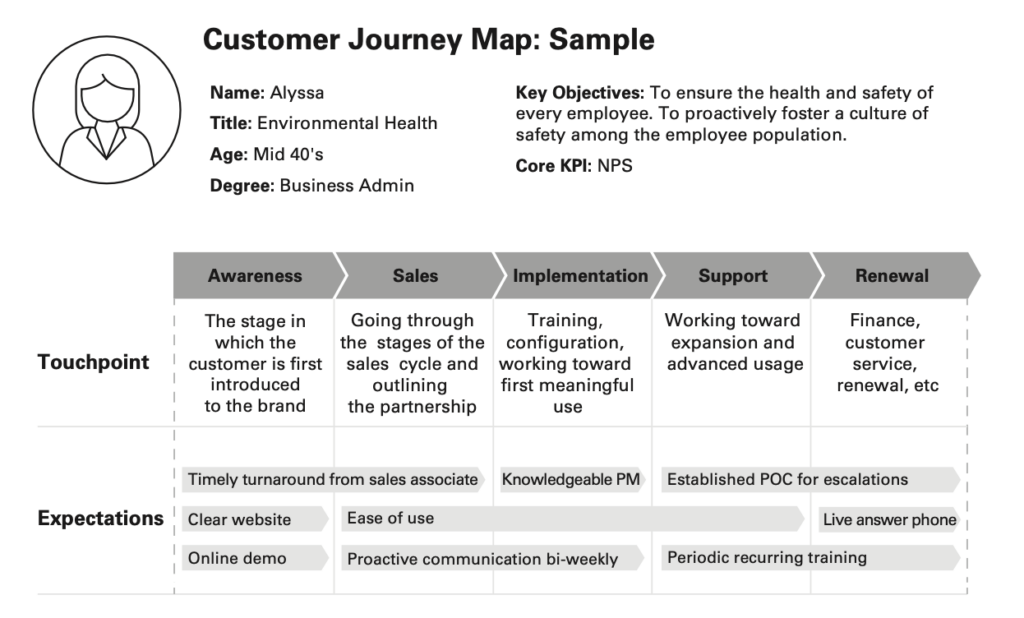
In this step, you add important information about the customer and their needs and expectations. The more actual customer feedback data you have, the better. If you’re early on in the process of collecting and managing customer feedback, making assumptions is okay. A “hypothesis map,” as we call it, is far better than no map at all.
To a large degree, customer experience is based on understanding customer expectations, and helping identify and influence them throughout the journey. You’ll want to capture customer expectations as accurately as possible at each touchpoint. Include a brief statement or set of bullets to outline the customer’s core needs and expectations at each touchpoint.
Remember, as much as possible, to build the journey from the customer’s perspective and in their vernacular. I’ve seen executives try to turn a customer journey map into an internal process map. Don’t let that happen! Creating an internal “service blueprint,” such as a customer access strategy is essential. But it’s not the same as a customer journey map. Politely guide your group back into the perspective of the customer.
Step 4: Identify pain points
The fourth and final step may be the most important. This is where you document potential friction points at each stage of the journey. You’ve captured the customer’s needs and expectations. Now, these are areas where you sometimes or often fail to meet those expectations. This is where the journey map becomes much more than a hypothetical exercise. It’s a strategic roadmap of how to improve the customer’s experience.
Ideally, any employee can look at the map and find the areas of the journey where they play a significant role. By illustrating pain points at that stage, they understand their part in improving customer experience. And that is the power of an effective journey map. Not only does it illustrate the entire journey, it also provides enough tactical direction to drive behavior change.
There are many additional insights you can include on a customer journey map. For example, you could show a relevant key performance indicator (KPI) for each touchpoint (I’ve included a before and after net promoter score (NPS)). An online search will reveal many examples of journey maps. Some are far more extensive than the example provided here. You’ll want to strike the right balance between detail and usability.
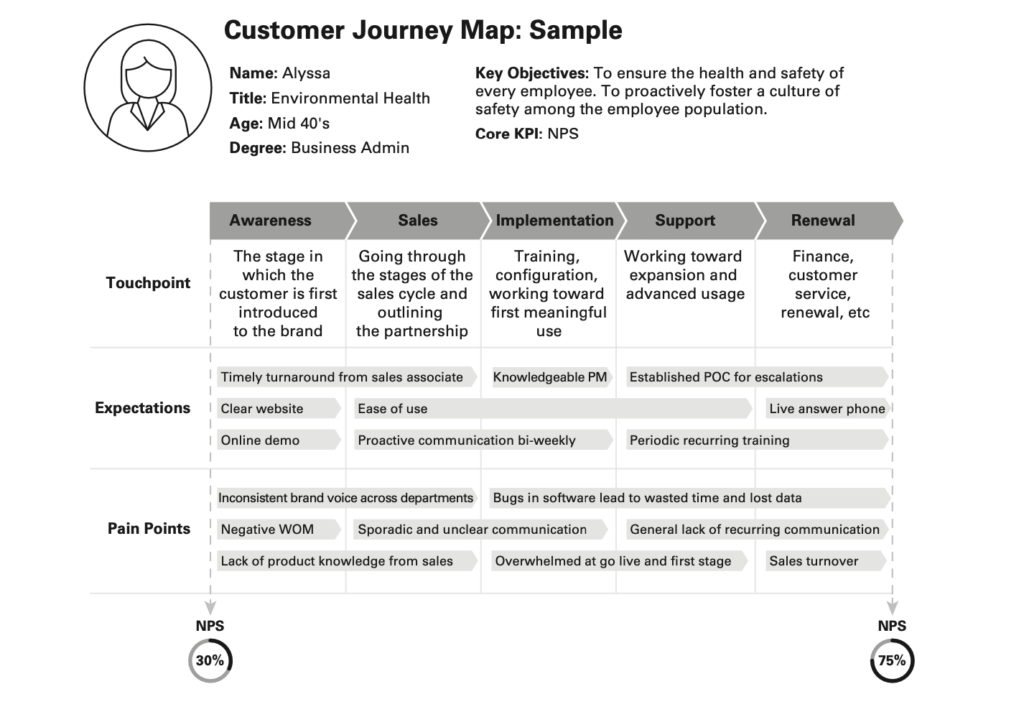
And now back to the question: Are your Customer Journey Maps gathering dust? A journey map is helpful in identifying pain points and improvement opportunities. But it has no effect unless you take action. I’ve seen robust analysis and beautiful maps in organizations that don’t move on to taking action. It’s only what you do that matters.


0 Comments